Inflammatory bowel diseases (IBD) like Crohn’s disease and ulcerative colitis are chronic inflammatory disorders of the gastrointestinal tract that can significantly affect patients’ quality of life and place a substantial burden on healthcare systems worldwide. People with IBD often face considerable delays across different stages of healthcare and treatment. In the UK, for example, around 500,000 people are affected by IBD, with approximately 25,000 new diagnoses each year, while current service provision continues to fall short of recommended standards for care and staffing.1
From Lab Delays to Real-Time Care: How a Fecal Calprotectin Home Test Transforms IBD Remote Monitoring
IBD is defined by uncertainty. Flare-ups can occur without warning, and clinical decisions often depend on data that arrives too late.
This creates a key challenge for healthcare systems: How can disease activity be monitored continuously — without increasing workload?
A case study from an NHS gastroenterology department in the UK shows how IBD remote monitoring can be fundamentally improved.
The Challenge: Delayed Insights and Limited Adherence
Fecal calprotectin is widely used to monitor IBD because rising levels can indicate increasing intestinal inflammation and potential disease flares, often before symptoms worsen.2 In traditional pathways, fecal calprotectin testing relies on centralized labs. Patients send samples by post and often wait for results. In the present example from the UK, patients wait up to 4 weeks for their results to come back. At the same time, only around 50% of patients completed testing due to logistical barriers and incovenience with the sample send-in.
For a disease where inflammation markers can rise before symptoms appear, this delay limits early intervention and increases the risk of avoidable hospitalisations.
The Solution: A Fecal Calprotectin Home Test as Point-of-Care Tool
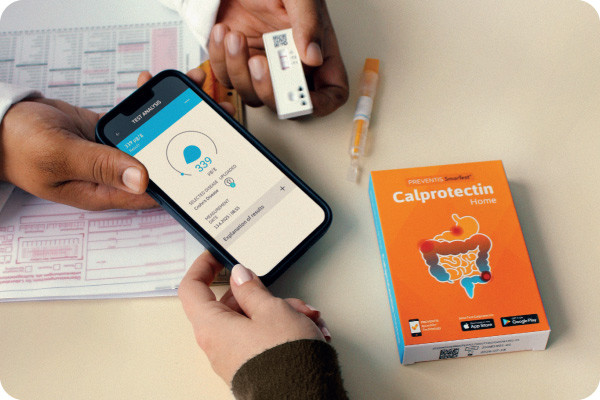
To address this, the hospital introduced a fecal calprotectin home test — Preventis SmarTest® Calprotectin Home — combining a quantitative lateral flow assay with smartphone-based analysis.
This enables calprotectin point of care testing at home:
- Results within minutes
- Quantitative results via app
- Direct integration into digital care pathways
The aim: to reduce the burden on patients, shorten the time from testing to result, and enable faster clinical decision-making.
The test was selected based on clinical validity, usability, and its ability to deliver reliable data directly into the hospital’s patient platform.
Learn more about the solution: Preventis SmarTest® Calprotectin Home
From Testing to True IBD Remote Monitoring
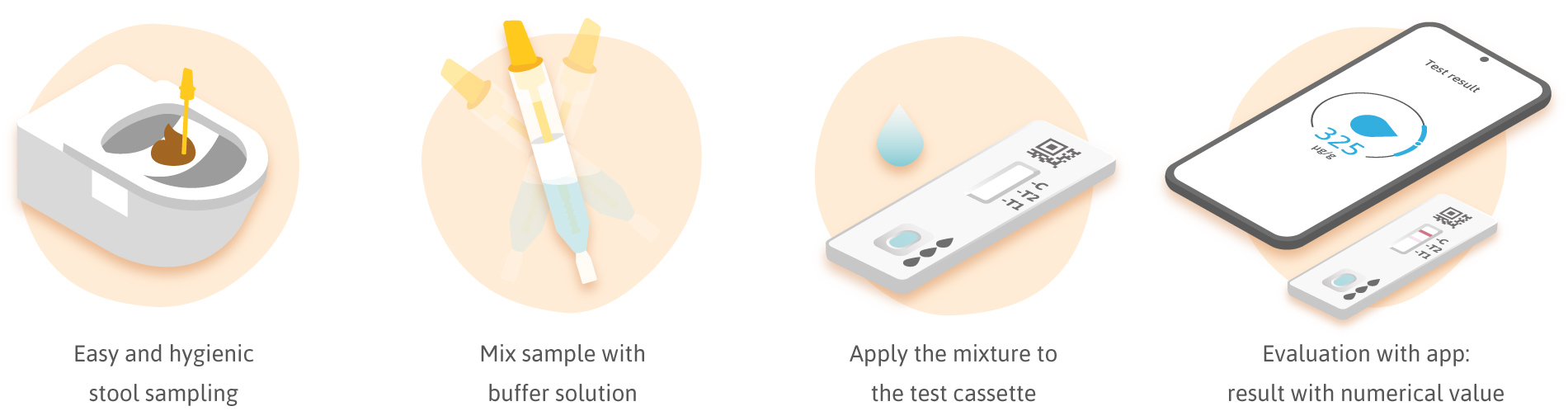
Preventis SmarTest® Calprotectin Home combines a rapid test with a smartphone app. A small stool sample is collected at home and mixed into a sample solution. The solution is then applied to the test cassette.
After 15 minutes, the app analyses the color intensity of the test strip and displays an immediate quantitative result. Because the result is captured digitally, it can also be shared digitally with the treating clinic — creating the basis for remote monitoring.
A critical success factor was seamless integration into existing infrastructure.
Test results were transferred directly into clinical systems and made available to the healthcare professional team, enabling near real-time clinical review.
This created a new model of IBD remote monitoring, where:
- patients can track disease activity continuously
- clinicians receive structured, actionable data
- follow-ups can be initiated proactively
In practice, this approach allows a form of digitally supported outpatient care—without requiring physical visits.
Impact: Faster Decisions, Better Resource Allocation
The implementation led to measurable improvements:
- Time-to-result reduced by up to 3–4 weeks
- Outpatient intervals extended from 118 to 364 days
- Reduced hospital visits and earlier interventions
By eliminating the need to transport stool samples from home to a clinic, laboratory, or postal service — a process many patients find uncomfortable — the home-testing approach also contributed to increase patient engagement significantly. Most users preferred the fecal calprotectin home test and actively used their results to trigger follow-ups.
For healthcare providers, this means more efficient use of clinical resources and better prioritisation of critical cases.
Why Healthcare Professionals Trust the Approach
Adoption was driven by clinical relevance and usability.
Healthcare professionals highlighted:
- increased confidence in assessing disease activity
- faster decision-making based on available data
- smooth integration into digital health records
This reflects a key principle: diagnostics must not only be innovative—they must be trusted in real-world clinical workflows.
See It in Practice — watch how healthcare professionals implemented this approach in a real clinical setting:
University Hospital Southampton Smartest testimonial - YouTube
A Scalable Model for New Markets
For partners, the most relevant insight is scalability. The model is built on three transferable elements:
- Validated fecal calprotectin home test technology
- Digital integration enabling IBD remote monitoring
- A point-of-care approach empowering patients
These components can be adapted across healthcare systems and markets, independent of local infrastructure.
Conclusion: A Proven Model for Modern Diagnostics
This case study demonstrates a clear shift:
- from delayed lab testing to calprotectin point of care diagnostics
- from reactive treatment to IBD remote monitoring
- from isolated results to continuous care
For partners, it represents a validated, scalable concept—ready to be implemented in new markets and healthcare environments.
